

The 5 Levels of Self-Talk

The voice in your head never takes a day off. It speaks more often than your boss, your partner, or your friends. And over time, it decides what you’ll chase, what you’ll settle for, and what you’ll quit on.
Shad Helmstetter, in What to Say When You Talk to Yourself, breaks this inner dialogue into five distinct levels. Each one programs your mind differently. The level you default to is the code your brain runs on. And that code is either helping you move toward your goals or sabotaging them.
Here’s the framework:
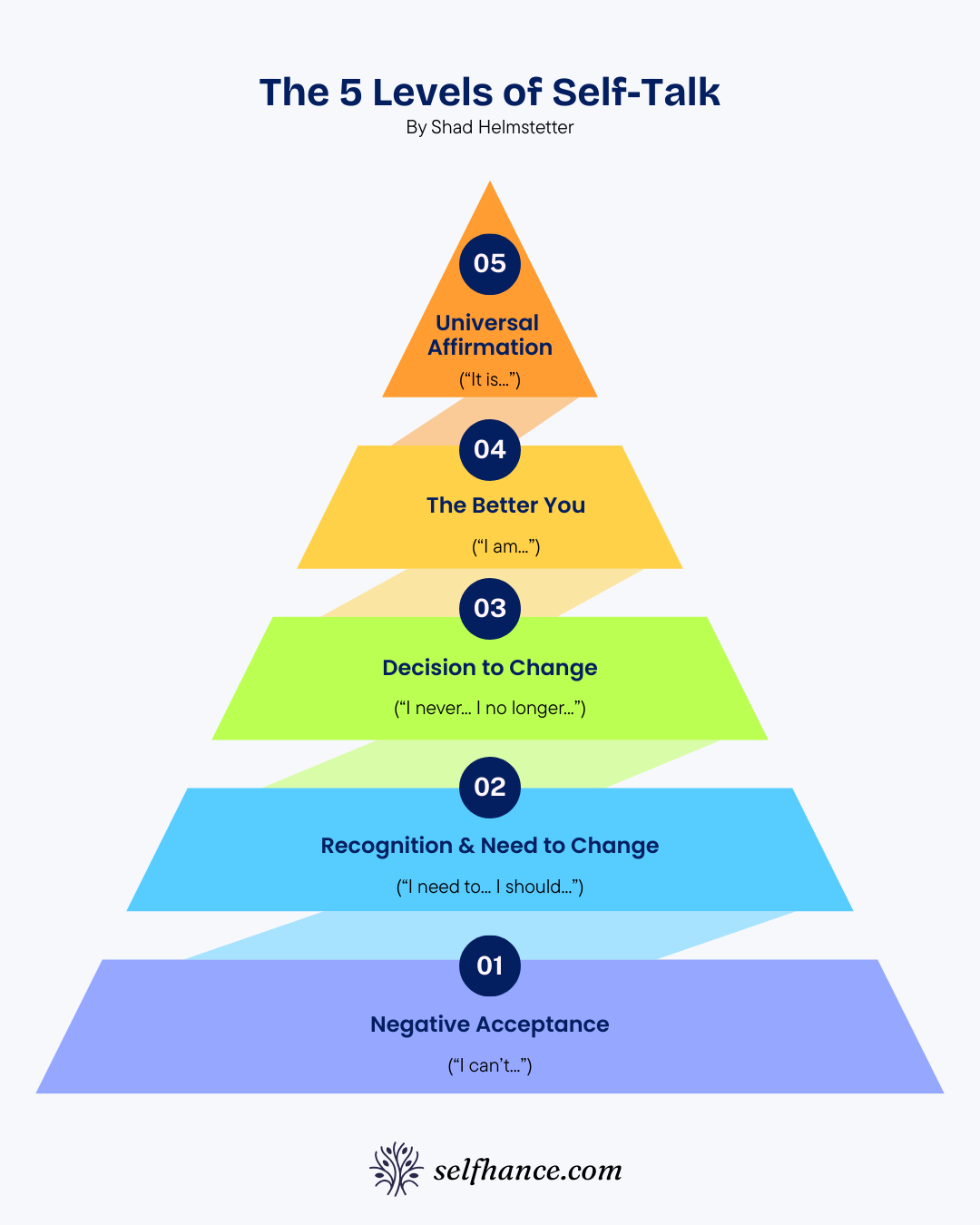
Level 1 – Negative Acceptance
Self-talk that accepts limitation or failure as fact.
Example: “I can’t do this.” / “I’m bad at math.”
Level 2 – Recognition, and Need to Change
Awareness without commitment — “should,” “need to,” and “ought to” phrases.
Example: “I should eat better.” / “I need to save money.”
Level 3 – Decision to Change
Present-tense decisions that mark a turning point.
Example: “I never overspend.” / “I no longer skip workouts.”
Level 4 – The Better You
Positive, present-tense statements that program your subconscious for new habits and beliefs.
Example: “I am confident and capable.” / “I make healthy choices.”
Level 5 – Universal Affirmation
Self-talk that affirms your unity with God, your higher self, or life itself. You speak from the deepest truths of your being, that you are connected, guided, and living in harmony with the very order of creation.
Example: “I am one with God’s love and wisdom.” / “I live in harmony with life itself.”
The closer you operate to Level 5, the more your self-talk works for you instead of against you. In the next section, we’ll see why these levels have such a powerful impact on your success, and what it takes to move upward.
The 5 Levels of Self-Talk Explained
Level 1 – Negative Acceptance
This is the most damaging level. You talk to yourself in ways that cement limitation and failure. The words are often absolute: “always,” “never,” “can’t,” “won’t.” You may not even notice how often they slip into your thoughts or speech.
Examples:
- “I can’t keep up with new technology.”
- “I’m terrible at public speaking.”
- “I always mess things up.”
When you speak like this, you’re not describing reality; you’re simply programming it. Your mind looks for evidence to confirm what you’ve said, which keeps you stuck in the same patterns.
Level 2 – Recognition, and Need to Change
At this level, you admit something could be better, but you don’t commit to action. The language here is filled with “should,” “need to,” and “ought to.” It creates the feeling of responsibility without the follow-through.
Examples:
- “I should get in shape.”
- “I need to be more organized.”
- “I ought to spend more time with my family.”
The problem? Your subconscious hears these as unfinished business. Without a clear decision or plan, nothing changes.
Level 3 – Decision to Change
Here, you decide to change and phrase it in the present tense. You’re not saying you will do something “someday”, you’re saying it’s true now. This shift is powerful because it tells your brain that the old pattern is over.
Examples:
- “I never smoke.”
- “I no longer let fear control my choices.”
- “I always follow my budget.”
Level 3 is the turning point. You’re no longer circling around the idea of change; you’ve declared it.
Level 4 – The Better You
This is active self-programming. You use present-tense, positive statements to create the identity and habits you want. Even if they’re not yet true, you say them as if they are.
Examples:
- “I am disciplined and focused.”
- “I enjoy exercising every morning.”
- “I speak with confidence in any situation.”
With repetition, these statements sink into your subconscious, influencing your automatic behaviors and responses.
Level 5 – Universal Affirmation
This is the highest form of self-talk. At this level, you affirm truths that go beyond specific goals or habits. You speak from and to your deepest identity. You declare your unity with God, your higher self, or the life force that flows through everything.
It’s self-talk that says: I am more than my circumstances. I am connected to something eternal. My life moves in harmony with the order of creation itself.
Examples:
- “I am one with God’s love and wisdom.”
- “I live in harmony with life itself.”
- “I am guided, protected, and empowered in all I do.”
When you operate at Level 5, you’re aligning with the very source of your being. This alignment fuels every other level of self-talk, making it easier to think, speak, and act from a place of strength and peace.
The five levels form a ladder. At the bottom, you speak to yourself in ways that keep you small. At the top, you speak from a place where nothing in your environment can diminish your worth, your peace, or your connection to what matters most.
Every step upward changes the way you think, the choices you make, and the results you create. You won’t move from Level 1 to Level 5 in a single leap, but you can get there with practice. Every time you replace “I can’t” with “I am,” every time you change “I should” to “I no longer,” you climb.
And when you reach Level 5, you stop climbing alone. Your words begin to flow from a deeper source — one that is bigger than your fears, bigger than your goals, and fully aligned with the life you were meant to live.
How to Move Up the Levels
Level 1 or 2 self-talk slowly shapes a life you didn’t ask for. Level 5 shapes one you can’t wait to wake up to. You don’t need to get it perfect right now. You just need to take the next small, intentional step. Let’s walk through the moves that keep you going forward.
1. Notice Your Default Level
- Keep a small notebook or phone note open for one day.
- Write down phrases you say to yourself, especially in moments of frustration, doubt, or decision-making.
- At the end of the day, label each one as Level 1–5. This builds awareness of your current patterns.
Recommended Resource: Self-Talk Tracker
2. Replace, Instead of Arguing With Yourself
When you catch a Level 1 or 2 phrase, don’t debate it in your head; replace it immediately with a Level 3–5 statement.
- Example: Change “I can’t do this” to “I am finding a way to do this.”
- Example: Change “I should exercise” to “I enjoy moving my body every day.”
3. Write You Words You Want to Believe
- Write 3–5 Level 4 or Level 5 statements that reflect who you want to be.
- Keep them in your phone, on your desk, or as sticky notes where you’ll see them daily.
- Repeat them out loud in the morning and before bed.
4. Anchor Your New Self-Talk to Routine
Pair your new self-talk with existing habits so it becomes automatic.
- Say your affirmations while brushing your teeth, walking the dog, or brewing coffee.
- This way, repetition happens without adding “one more thing” to your day.
5. Surround Yourself With Higher-Level Language
- Listen to audio programs, sermons, or meditations that use Level 4 and 5 language.
- Spend time with people who speak about themselves and life in empowering ways.
- Limit conversations where negative self-talk is the norm.
6. Expect Resistance, But Keep Going
Some old phrases will cling. That’s normal. You’re rewiring years of mental programming.
- See slips as reminders, not failures.
- Keep practising; the repetition builds new pathways until higher-level self-talk becomes your default.
Start Climbing Today
Your self-talk is the language you use to build your life. Every sentence you whisper to yourself is a brick, laid one after another, until you’ve built something you have to live inside.
You won’t move from Level 1 to Level 5 in a single leap, but you can get there with practice. And each step upward changes how you see yourself, what you believe you can do, and how you respond to life’s challenges.
So start today.
- Catch one Level 1 or 2 phrase and replace it.
- Write down one Level 4 or 5 statement and repeat it.
- Keep climbing until your everyday language comes from the place where you are one with God, in harmony with life itself, and fully aligned with the person you’re meant to be.
Your words are shaping your future right now. Make them worthy of the life you want to live.